Showing posts with label power providers nz. Show all posts

Friday, July 31, 2020

Profiling China and the world’s other top energy producers

 With a seemingly insatiable demand for energy to power the global economy, NS Energy profiles the top five electricity producing nations around the globe — as the world enters an unprecedented period of shifting priorities from traditional to renewable solutions.

When it comes to regional share, the Asia Pacific region claimed 12,273.6 terawatt-hour (TWh) and a 46.1% share in the world’s total electricity generation last year, followed by North America with 5,447.3TWh and a 20.5% share of the global total.

Africa generated the least power in 2018 at 853.7TWh — however, this figure equates to a healthy 2.9% increase over the previous year.

Driven by growing concerns towards climate change, the world’s renewable energy generation grew 14.5% to 2,480.4TWh in 2018, according to BP Statistical Review of World Energy 2019 report.

Here we look at where the power currently lies around the world.

China – 7,111.8TWh

China is by far the world’s most prolific producer of electricity, generating a significant amount of its power from coal followed by hydroelectricity.

The country operates one of the biggest coal-powered plants in the world, the 6.7 gigawatt (GW) Datang Tuoketuo facility in Inner Mongolia. The fuel is sourced from the Junggar Coalfield located 50km from the plant.

China is also the largest renewable energy producer in the world, with a generation capacity twice that of the US — which is ranked second in the world. The country generates nearly half of its renewable energy from hydropower plants. Its installed renewable energy generation capacity stood at 695.8GW in 2018, according to a report by the International Renewable Energy Agency (IRENA).

The country operates some of the largest hydropower projects in the world, which includes the 22.5GW Three Gorges hydroelectric power complex.

Wind and solar are the other major sources of renewable energy in China. The country is home to the world’s biggest photovoltaic power plant, the 1.54GW Tengger Desert Solar Park in Ningxia.
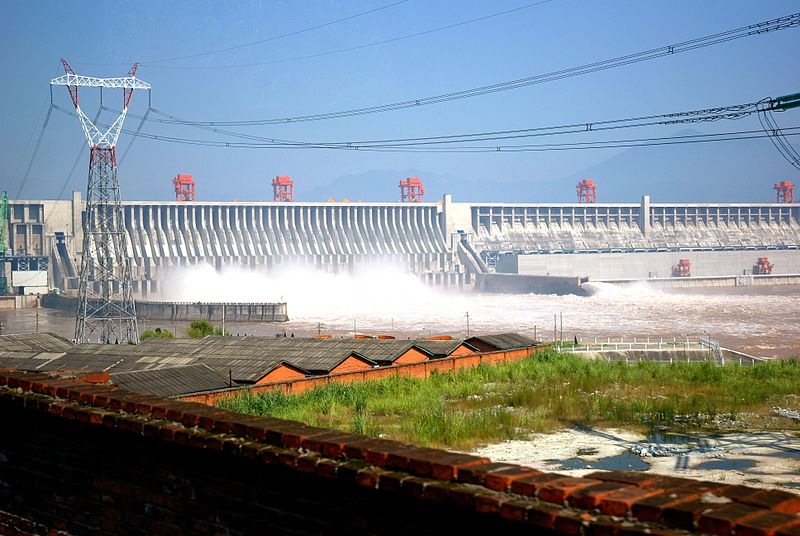
The Three Gorges Dam (Credit: Allen Watkin from London, UK/Wikipedia.org)


US – 4,460.8TWh

The US is the second-largest producer of electricity in the world. The country produces 35% of its power from natural gas and other gases, along with 27% from coal.

Nuclear power plants generate nearly 20% of the country’s total electricity, according to the figures provided by the US Energy Information Administration.

Some of the biggest nuclear power plants in the US include the 3.9GW Palo Verde Generating Station located nearly 88.5km west of downtown Phoenix near the town of Wintersburg, Arizona, and the 3.4GWthe Browns Ferry Nuclear Plant located on the Tennessee River near Decatur and Athens, Alabama.

The country’s major coal power plants include the 3.6GW Robert W Scherer Power Plant — which can supply enough energy to power nearly 1.5 million homes — the 3.3GW Monroe Power Plant, owned by the DTE Energy Electric Company, and the 3.3GW Plant Bowen.

Some of the biggest solar and wind power facilities in the country include:

  • the 579MW Solar Star power plant,
  • the 552MWCopper Mountain Solar facility,
  • the 550MW Topaz Solar Farm,
  • the 1,5GW Alta Wind Energy Centre,
  • the 910MW Los Vientos Wind Farm,
  • and the 845MW Shepherds Flat Wind Farm.


India – 1,561.1TWh

India is third in the list of global electricity producers, generating a significant amount of its power from coal — with more than 65% of the country’s electricity coming from thermal power plants.

Some of it biggest thermal power plants include the 4.7GW Vindhyachal Thermal Power Station in the Singrauli district of Madhya Pradesh, the 4.6GW Mundra Thermal Power Station located in the Kutch district of Gujarat and the 4GW Mundra Ultra Mega Power Plant (UMPP), also located in the Kutch district of Gujarat.

India also generates a considerable amount of electricity from hydropower, including: the 1.45GW Sardar Sarovar project in Gujarat operated by Sardar Sarovar Narmada Nigam, the 816MW Nagarjuna Sagar project in Telangana operated by TSGENCO, and the 435MW Bansagar project owned by the Madhya Pradesh Water Resources Department.

Power produced by wind and solar facilities account for 29.8% and 22.8%, respectively, of the country’s total renewable energy capacity. The 1.5GW Muppandal wind farm in Tamil Nadu developed by the Tamil Nadu Energy Development Agency, the 1.27GW Jaisalmer Wind Park in Rajasthan developed by Suzlon Energy, and the 528MW Brahmanvel wind farm developed by Parakh Agro Industries in Maharashtra are its major wind power facilities.

The 1GW Kurnool Ultra Mega Solar Park in Andhra Pradesh owned by the Andhra Pradesh Solar Power Corporation (APSPCL) is one of the biggest solar facilities in the country.
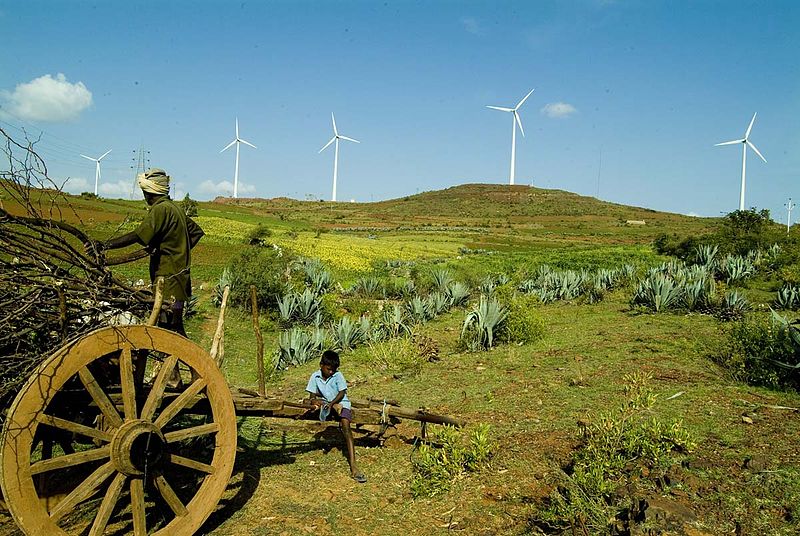
Field and wind turbines in India (Credit: Yahoo! Blog from Sunnyvale, California, USA/Wikipedia.org)


Russia – 1,110.8TWh

Russia is the fourth largest electricity generating country in the world, with a production of 1,110.8TWh in 2018. The country accounts for 4.2% of the total electricity generation in the world.

The country has an installed electricity generation capacity of more than 220GW coming from nearly 440 power plants.

Most of the power generation in Russia is from gas- and coal-fired plants, while renewable energy generation contributed only 1.3TWh in 2018. However, there was a 10.5% growth in power generated from renewable sources in 2018 compared with 2017.

When it comes to nuclear power, Russia has 31 reactors in operation with an installed power generation capacity of 21GW.

Overall, the largest power plant in Russia is the 6.4GW Sayano-Shushenskaya hydropower project, built along the Yenisei River, near Sayanogorsk in Khakassia. Operating since 1978, the Sayano-Shushenskaya hydropower project contributes around 23.5TWh of electricity generation annually in Russia.

Other major power plants in Russia are the 6GW Krasnoyarsk Hydroelectric Power Station, the 4GW Balakovo Nuclear Power Plant, and the 3.6GW gas-fired Kostroma Power Station.


Japan – 1,051.6TWh

Japan is the fifth-largest electricity generating country in the world with a production of 1,051.6TWh in 2018. The East Asian country has a 4% share of the overall electricity generation in the world.

The country’s electricity generation from renewable sources in 2018 stood at 112.1TWh, an increase of 13.5% from 2017.

Until the Fukushima Daiichi nuclear disaster in 2011, Japan had traditionally depended on nuclear power generation, as the country does not have abundant quantities of domestic reserves of fossil fuel, crude oil and natural gas.

According to The Federation of Electric Power Companies of Japan (FEPC), the East Asian country depends on imports for 94% of its main energy supply needs.

Other than nuclear power, hydroelectric and solar plants make a significant contribution to Japan’s power generation.

Japan is home to one of the 10 largest power plants in the world, the 7.96GW Kashiwazaki-Kariwa nuclear power plant, on the coast of the Sea of Japan, in Niigata Prefecture.

Read more: electricity suppliers

Thursday, June 11, 2020

Connecting your solar panels to a home battery: good idea?

The home battery is increasingly making the news. More and more new models are coming onto the market, technology is improving, prices are falling and there is even an interesting subsidy for Flanders. But is now the time to invest in a home battery? We figured it out for you.

What is a home battery?

A home battery is your store of solar energy that you produce too much. After all, according to UGent figures, we only use 30% of our products directly, 70% we put on the public electricity grid. We pay a levy for this in Flanders and Wallonia: the prosumer rate. This compensation is because you use the electricity network to set up and purchase energy. Check electricity nz.

A home battery, therefore, saves the excess power from your solar panels. As soon as your panels produce more than your consumption, the home battery starts to charge. You use that power at times when the sun does not provide energy. The most common systems can store between 3 kWh and 8 kWh. On average, a family consumes around 10 kWh per day. That means that a home battery can not fully insure your power needs, but still a good deal. Unless you take a larger (and therefore more expensive) battery.

There are three advantages to a home battery

The first is, of course, that you use more self-produced energy and therefore have to draw less power from the grid - and thus save.

The second advantage is that you no longer pay a prosumer rate because with a home battery you don't need a counter that turns back. We will explain how this works later.

The third advantage is that you have your own power supply and therefore switch to your home battery in the event of a power failure. There is even a fourth advantage for Flanders: subsidy. You get back up to 35% of your investment costs, up to € 3200. This automatically brings us to the biggest stumbling block: the price.

What does a home battery cost?

New technology is usually expensive and so is the home battery. In addition, the higher the storage capacity, the higher the price. For a 3 kWh battery, you have to count on € 4,000. For an 8 kWh model, this increases to € 8,000 and for a power of 14 kWh, this is about € 10,000. For Flanders, you may deduct the subsidy of € 250 per kWh, with a maximum of € 3,200 or 35%. A number of conditions are attached to the subsidies. You can find electric vehicles nz

Of course, you not only look at the costs but also at the return. Three things play a role there.

 The quality of the battery can make a big difference. A top-quality lithium-ion battery provides 95% efficiency while a lower quality, the cheaper battery can be 70% effective
The number of charging cycles or the number of times your battery can store and return power. Top models achieve up to 10,000 cycles, most basic models around 5,000.
The peak consumption of your electricity. You have to plan your consumption smartly so that production, consumption, and capacity are well balanced. Then you need to get as little energy as possible from the public grid and save.


There is also a fourth factor: the prosumer rate. You pay this levy (not in Brussels) if you have a reversing counter. How much you pay depends on the power of your inverter. So not from your actual production. If you no longer have a revolving meter, the prosumer rate will lapse and you will immediately save. The reversing counter is less interesting with a home battery anyway. After all, you first charge your battery, and only then does the rest go to the public network.

If you keep your rev counter, you can have a converter with a lower power installed. As a result, your prosumer rate decreases, without jeopardizing your production.

Just as technical

A home battery may need an additional inverter to do its job. The inverter for your solar panels converts direct current into alternating current. For direct use, to put on the public network or for your home battery. The system works in one direction, but your home battery must also be able to return the stored power. And for that, you need the extra converter that converts the alternating current back into direct current. On some models, the two-way interface (direct current <-> alternating current) is already provided thanks to the built-in inverter.

Low efficiency in the winter

About 70% of solar panel production is in late spring, summer, and early fall. The days are longer and the sun shines more often. But in the dark and rainy months, your solar panels have no overproduction. Your home battery will not be able to store excess energy and will therefore not be profitable. You can also only store a limited amount of energy, so your home battery will have to be unemployed during this period.

A calculation

Paying back your home battery: that is not feasible today. We have made a calculation of what you invest and what it yields.

An average family uses about 3600 kWh annually. If it has solar panels with a power of 4 kW, it can generate about 70% of its electricity itself. This means that it must take 1080 kWh from the electricity grid. That comes with the current prices at € 270. There is the advantage that the prosumer rate is eliminated because the family no longer has a 'reversing' counter. 

The purchase price of a home battery is around € 5,000. As a result, it takes more than 50 years for the investment to become profitable. However, the life of a home battery is up to 20 years.

Thursday, May 14, 2020

10 tips if you want to save energy without losing comfort

Using less energy, using energy at the right time or not using energy unnecessarily: there are various ways to reduce your consumption - and therefore your energy costs. The good news: little things often make for interesting savings. Here you have 10 examples that will probably work for you too.

1. Energy-saving cooking: the pressure cooker

A pressure cooker or pressure cooker does not release steam like a regular pan. This creates high pressure and accelerates the cooking time: you only need two-thirds of the normal cooking time. This ensures that your energy consumption is reduced by as much as 50%. In addition, your food is ready faster and the vitamins and taste are better preserved. So only benefits.

2. Energy-saving cooking: wok cooking

The wok is a very energy-friendly way to cook for two reasons. In the first place, you prepare your dishes with woks short but fierce. The cooking time is therefore limited, which means that your stove does not have to work for a long time. In addition, the wok is a one-pan dish: you can put all ingredients in the same wok pan. So you only need one burner or hob. Also a nice bonus: you have fewer dishes! 


3. Energy-saving washing: fill your drum

Washing costs a lot of energy and you often use your washing machine. Reasons enough to wash smartly. You can achieve significant savings by only running a full washing machine. The 'half wash' program actually saves you little because heating water is the greatest cost. Do you already have a solar water heater? Then choose a 'hot fill system. The hot water then enters the machine directly. This way you save 50% on energy.

4. Energy-saving drying with a heat pump

A classic condenser dryer heats the air with an electric heating element. The new heat pump dryers use the moist air that comes out of your drum. How does that work? A coolant condenses the moisture and is reused as dry air. That quickly saves you half of the electricity compared to an A + condensation dryer. Heat pump dryers are slightly more expensive to purchase, but your savings are much greater.

5. Energy-saving washing with the delay button

Do you have a double meter and do you use electricity at night (and on weekends) for a lower price? Then the delay button is the solution to lower your energy costs. This function is on your washing machine, dishwasher, and dryer. This way you can easily set the start time and you do not have to wait for the nightly rate period to start.

6. Energy-saving heating with the smart thermostat

Heating costs make up about 60% of your total energy budget. That is where you can get the most profit. The easiest way is to install a smart thermostat. It automatically regulates the ideal temperature and saves up to 31% energy. This is mainly because you never heat unnecessarily thanks to the smart thermostat. You can read how this works exactly here.

7. Energy-saving living: opt for HR ++ glass

HR ++ glass is double glass with 2 layers of insulation. This has the advantage that you do not have condensation on the inside and that the heat stays better in your home. HR ++ glass is up to 20% more energy-efficient than double glass. HR ++ glass (U value 1.2) has an insulation value 2.5 times higher than 'normal' double glass (U value 2.7). If you are going to renovate, this is the ideal time to save on your energy costs and increase your comfort with HR ++ glass.

8. Energy-saving living: request an energy scan or energy audit

How do you find out how your home can be more energy efficient? That is not easy, but fortunately, there is professional help. The Flemish government has an energy scan that is even free for certain groups. A specialist will visit and point out the important points for improvement. The advice is without obligation. An energy audit is a second possibility. It is more in-depth than an energy scan: you receive an energy performance certificate from your home and detailed advice. The costs depend on the size of your home. But you do have substantiated advice to invest and thus save.

9. Energy-saving lighting: intelligent lighting

Saving on the energy costs of your lighting is easy. LED lighting consumes 85% less than an incandescent lamp. But it is also worthwhile to discover the benefits of intelligent lighting. This lighting works with motion sensors. When you leave a room, the light goes out. You can also turn off all lights at the touch of a button - even when you're not at home - and simply program the light intensity. Intelligent lighting is easy to install via your home network, making an application very accessible.

10. Energy-saving cooling with these practical tips

A refrigerator works day and night, but you can make it work a little less hard. The first way: ensure good ventilation around the refrigerator. If the dissipated heat cannot escape properly, and thus blocks, the refrigerator uses extra energy to reach the desired temperature. Also, check that there are no cracks in the rubber seals on the door. This way, no cold can escape. The last tip is the easiest: put what you often need in the front of the refrigerator. Then you don't have to leave the door open for too long. Because that is an important cause of extra energy consumption.